For Three Decades, Hospitals Across the South Paid Royalties to a Man Whose Only Office Was a Barber Chair
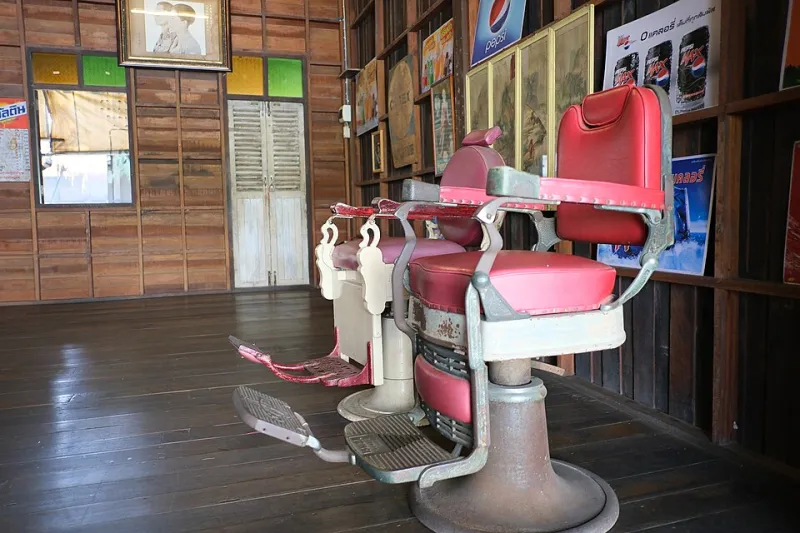
Photo: PattayaPatrol, CC BY-SA 4.0, via Wikimedia Commons
The United States Patent Office does not ask for your credentials. It asks whether your invention works, whether it's original, and whether you've filled out the forms correctly. For most of American history, this was considered one of the democratic virtues of the patent system — the idea that a good idea is a good idea regardless of where it came from.
A barber in rural Tennessee named Calvin Pruett understood this better than most. He spent three decades testing the theory from behind a very unusual set of paperwork.
The Crisis That Started It
In the early 1930s, the community around Pruett's shop in a small town in the eastern Tennessee hills was dealing with a recurring problem that fell somewhere between a medical issue and a public health nuisance. The nearest physician was more than thirty miles away over roads that turned impassable in wet weather. Minor but painful conditions that required simple intervention — infected cysts, small abscesses, the kind of localized problems that a trained clinician could address in minutes — were instead left to fester because there was simply no one available to treat them.
Pruett, who had been cutting hair in the same shop since the mid-1920s and had developed a reputation as someone people brought their problems to in a general sense, began reading. He obtained medical texts through a mail-order book dealer. He corresponded, under a vague professional description, with a physician in Knoxville who apparently never asked too many questions. And he experimented, carefully, on willing patients who had no other options.
What he developed was a specific drainage and closure technique for subcutaneous infections — a method of incision, irrigation, and temporary packing that reduced recurrence rates compared to the cruder approaches then common in rural first-aid practice. It was not complicated. It was not revolutionary. But it worked reliably, it was teachable, and it left patients measurably better off than before.
The Name on the Patent
By the late 1930s, Pruett had refined his technique enough that a local attorney — who was also a customer and apparently a man of flexible professional boundaries — suggested it might be worth protecting. Filing a patent under his own name was, they both agreed, likely to invite problems. The medical establishment of the 1930s was not known for welcoming unsanctioned innovation from uncredentialed practitioners, and the legal exposure of practicing medicine without a license was real, even if the community's gratitude was genuine.
The solution they arrived at was elegantly simple. Pruett filed the patent under the name C.H. Merritt — a name he apparently selected because it sounded appropriately professional and did not belong to anyone he knew. The patent application described the technique in clinical language, cited the relevant prior literature accurately, and was granted without incident in 1938.
The attorney handled the licensing correspondence. Royalty checks arrived at a post office box. The amounts were modest at first — small clinics in Tennessee, Georgia, and Alabama adopting the technique through medical supply catalogs that included procedural licensing documentation as standard practice. Over time, as the technique spread through regional medical education networks, the checks grew.
Pruett, by all available accounts, continued cutting hair. He reportedly used the royalty income to pay for his children's education and to buy a better building for his shop. He told almost no one.
Thirty Years of Successful Secrecy
The arrangement held for an almost implausible length of time. The patent was renewed. Licensing agreements were maintained. At least two medical journal articles cited the Merritt technique by name without anyone apparently attempting to identify or contact the inventor. The attorney who had set up the arrangement died in the 1950s, and Pruett managed the correspondence himself thereafter, maintaining the fiction through carefully typed letters on plain stationery.
What eventually unraveled it was not investigative journalism or a suspicious licensing auditor. It was a graduate student.
In the late 1960s, a medical history researcher at Vanderbilt University became interested in the origins of the Merritt technique as part of a broader study of procedural innovations in rural Southern medicine. Attempting to locate primary sources, she traced the patent filing to a post office box, which led to a forwarding address, which led — after considerable persistence — to a barbershop in eastern Tennessee.
 Photo: Vanderbilt University, via images.squarespace-cdn.com
The man behind the chair was in his seventies by then. He confirmed everything.
The Reaction That Revealed the Real Story
The researcher's eventual paper on Pruett was published in a medical history journal in 1971. The response from the medical community was, to put it diplomatically, mixed.
Some physicians were genuinely impressed. A technique that had been in clinical use for thirty years without a single documented complication attributable to the method itself was hard to argue with on purely empirical grounds. A handful of doctors who had trained on the Merritt technique said, essentially, that they didn't care who had invented it.
Others were less gracious. The phrase "practicing medicine without a license" appeared in several letters to the editor. There were calls to revisit the patent's validity on the grounds that the applicant had misrepresented his credentials — a legal argument that went nowhere, since the patent application had never actually claimed any medical credentials at all. C.H. Merritt, as described in the filing, was simply an inventor. The Patent Office had not asked for a diploma.
Pruett, interviewed by a Nashville newspaper shortly before his death in 1974, expressed no particular bitterness about the controversy. He said he had learned a long time ago that people are more comfortable with ideas once they know where the ideas came from. He had simply made sure they were comfortable with the idea first.
What a Barber Understood That a System Didn't
The story of Calvin Pruett is not really about a clever con. He didn't steal anything. He didn't harm anyone. He identified a problem, developed a solution, and navigated a system that would have rejected him on sight by removing his name from the equation entirely.
What's genuinely strange — and genuinely worth sitting with — is that it worked. For thirty years, the technique spread, was taught, was used on real patients, and improved real outcomes. The credential question only became urgent once a face was attached to the method.
The patent system, it turns out, really does just ask whether the thing works. It was the people who came after who needed something more.