Mike the Headless Chicken: How a Botched Dinner Became America's Most Impossible Celebrity
The Dinner That Went Horribly Right
Lloyd Olsen thought he was preparing a perfectly normal Sunday dinner on September 10, 1945, when he grabbed his axe and headed to the chicken coop on his farm in Fruita, Colorado. His mother-in-law was coming for dinner, and she had specifically requested chicken. What happened next defied everything Olsen thought he knew about biology, death, and the basic requirements for staying alive.
Olsen selected a five-and-a-half-month-old Wyandotte rooster and brought the axe down with practiced precision. The head came off cleanly — but the chicken didn't fall over. Instead, it stood up, shook itself off, and began walking around the yard as if nothing had happened.
"I thought I was losing my mind," Olsen later told reporters. "That bird was acting more lively without his head than most chickens do with one."
The Chicken That Broke the Rules of Life
What Lloyd Olsen had accidentally created was a biological impossibility that turned out to be entirely possible. The axe had missed the jugular vein and left most of Mike's brain stem intact. In chickens, the brain stem controls basic functions like breathing, heart rate, and reflexes — essentially everything needed to stay alive, just not much for thinking or seeing.
Mike couldn't eat normally, so Olsen fed him with an eyedropper, giving him water and ground-up corn directly into his esophagus. Not only did Mike survive, he actually thrived. The headless rooster gained weight, growing from about 2.5 pounds to nearly 8 pounds over the following months. He would attempt to preen his feathers, "peck" for food with his neck stump, and even tried to crow — producing only a gurgling sound that somehow became endearing to audiences across America.
From Farm Oddity to National Sensation
Word of the headless chicken spread quickly through rural Colorado, and within weeks, curiosity seekers were driving from Denver and beyond to see Mike for themselves. Lloyd Olsen realized he had something special on his hands — or wings, as it were.
Olsen contacted a local promoter, who immediately saw the commercial potential. By October 1945, Mike was touring the country as a sideshow attraction, drawing crowds at 25 cents per person (about $3.50 in today's money). The act was billed as "Mike the Headless Wonder Chicken" and became one of the most popular traveling exhibitions of the post-war era.
Mike appeared in Time and Life magazines, was photographed by National Geographic, and even inspired a 1947 recording called "The Ballad of Mike the Headless Chicken." At the height of his fame, Mike was earning Lloyd Olsen about $4,500 per month — more than most American families made in an entire year.
The Medical Mystery That Advanced Science
What made Mike truly remarkable wasn't just his survival — it was what his case taught medical researchers about the brain and nervous system. Dr. Tom Smulders, a neurobiologist at Newcastle University who studied Mike's case decades later, explained that Mike accidentally became one of the most important examples of brain stem function in medical literature.
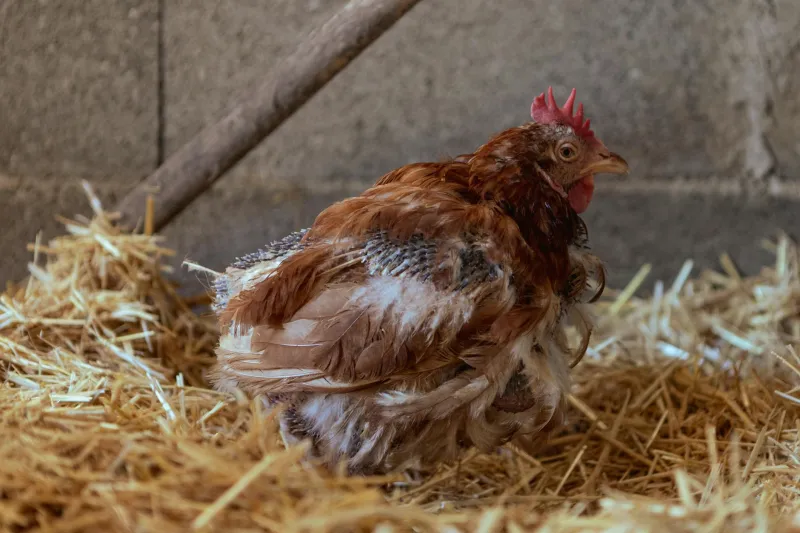
 Photo: Newcastle University, via www.world-guides.com
"Mike demonstrated that consciousness and survival are controlled by completely different parts of the brain," Smulders noted. "He could live, move, and react to stimuli without any higher brain function whatsoever."
Mike's case became a cornerstone example in medical schools for teaching about brain stem injuries, comas, and the difference between biological life and consciousness. Modern discussions about brain death, vegetative states, and end-of-life care often reference Mike as an extreme example of how the body can continue functioning without higher brain activity.
The Science Behind the Impossible
The key to Mike's survival lay in the precise location of Lloyd Olsen's axe blow. The cut had severed Mike's head just above the brain stem, leaving the medulla oblongata — the part of the brain that controls automatic functions like breathing and heart rate — completely intact. A blood clot had formed at the site of the injury, preventing Mike from bleeding to death.
Chickens have a unique anatomy that made Mike's survival possible. Their brain stems are proportionally larger than those of mammals, and they control more basic functions. Additionally, chickens can survive with much less oxygen than mammals, and their circulatory system is more distributed throughout their body.
Researchers who examined Mike found that he retained about 80% of his original brain mass, just not the parts responsible for sight, hearing, or complex behavior. He was essentially a biological robot, capable of all the basic functions of life but none of the experiences that typically define consciousness.
The End of an Era
Mike's remarkable life came to an end in March 1947, eighteen months after losing his head. While staying at a motel in Phoenix during a touring stop, Mike began choking on a kernel of corn. Lloyd Olsen had forgotten the syringe he normally used to clear Mike's throat, and without it, there was nothing he could do. Mike died not from his injury, but from choking — a fate that could have befallen any chicken.
By the time of his death, Mike had traveled across 25 states, been featured in dozens of publications, and earned Lloyd Olsen enough money to buy a new farm and send his children to college. More importantly, Mike had inadvertently contributed to medical science in ways that researchers are still discovering.
The Legacy of America's Most Famous Chicken
Today, the town of Fruita, Colorado, holds an annual "Mike the Headless Chicken Festival" every May, complete with a 5K run, live music, and a contest to see who can run the farthest while balancing a rubber chicken on their head. Mike's story has been featured in medical textbooks, biology courses, and countless "believe it or not" compilations.
But perhaps Mike's most important legacy is what he taught us about the nature of life itself. In an era when medical technology is constantly pushing the boundaries of what it means to be alive, Mike the Headless Chicken remains a reminder that biology is far stranger and more resilient than we often imagine.
Sometimes the most important scientific discoveries come from the most unexpected places — even a Colorado chicken coop on a Sunday afternoon in 1945.