This Man Was Standing Under Not One But Two Atomic Bombs — And Then Outlived Almost Everyone
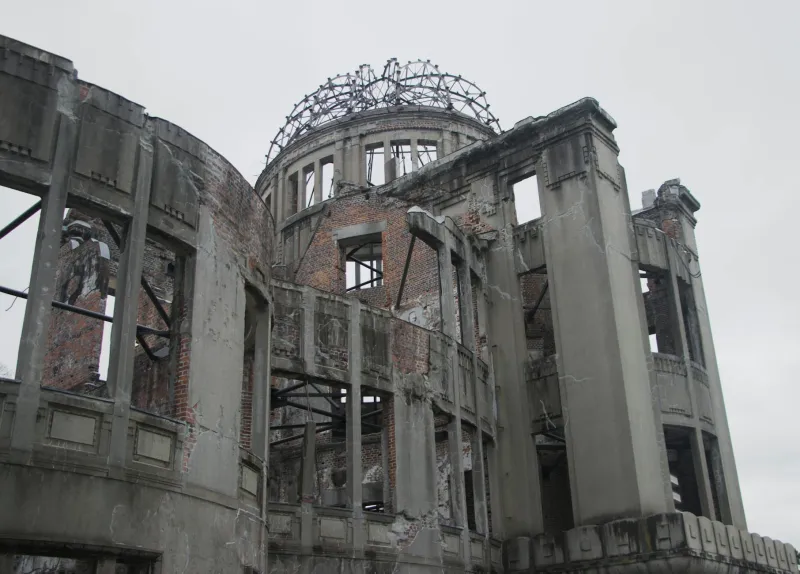
This Man Was Standing Under Not One But Two Atomic Bombs — And Then Outlived Almost Everyone
Let's say someone told you they had survived a nuclear explosion. You'd probably call that the most remarkable thing you'd ever heard. Now imagine that same person survived two of them — the only two ever used in warfare — three days apart, in two different cities, in what remains the most destructive week in human history.
You'd tell them to stop making things up.
But Tsutomu Yamaguchi did not make things up. He was a real person, a mild-mannered naval engineer from Nagasaki, and his story is so thoroughly documented that the Japanese government eventually had no choice but to officially certify it. He is the only person on record confirmed to have survived both atomic bombings of 1945. He died in 2010 at the age of 93 — of stomach cancer, which, all things considered, almost feels like the universe finally catching up with him after six and a half decades of trying.
Wrong Place, Wrong Time — Twice
In the summer of 1945, Yamaguchi was 29 years old and working as a draftsman for Mitsubishi Heavy Industries. He had been sent to Hiroshima on a three-month work assignment, and by early August, he was wrapping things up and preparing to go home to Nagasaki.
On the morning of August 6th, he was walking toward the shipyard when he realized he had forgotten his hanko — a personal stamp used in Japan to sign documents. He turned back to get it. That small, bureaucratic detour likely saved his life, because it delayed him just long enough that when the Enola Gay dropped Little Boy at 8:15 a.m., Yamaguchi was roughly two miles from the hypocenter rather than closer to the blast zone.
The explosion knocked him off his feet, ruptured his eardrums, temporarily blinded him, and burned a significant portion of his upper body. The city around him was, in the most literal sense, gone. He spent the night in an air raid shelter and, after finding two colleagues who had also survived, made his way to a train station. He boarded a train and rode it home to Nagasaki.
He arrived on August 8th.
The Universe, Apparently, Was Not Done
On the morning of August 9th, Yamaguchi — bandaged, burned, and barely recovered — reported to work at the Mitsubishi offices in Nagasaki to brief his supervisor on what had happened in Hiroshima. His supervisor, by most accounts, did not believe him. The idea that a single bomb could destroy an entire city was, at that point, beyond comprehension.
Yamaguchi was in the middle of describing the blast when, at 11:02 a.m., Fat Man detonated approximately two miles away.
The white light filled the room. Again.
He survived the second explosion as well, sheltered somewhat by the building around him. His existing wounds were worsened. He stumbled home through a burning city to find his wife and infant son, who had also survived. The family eventually recovered, though the psychological and physical toll lasted for the rest of their lives.
A Life Spent in the Shadow of Two Mushroom Clouds
For decades, Yamaguchi rarely talked about what had happened to him. He suffered from radiation-related health problems throughout his life — recurring fevers, hair loss, and eventually the loss of hearing in one ear. Two of his children died of cancer, which he attributed to radiation exposure, though this was never formally established.
It wasn't until 2006 that the Japanese government officially recognized him as a nijū hibakusha — a double bomb survivor. There were others who had been in both cities during the bombings, estimates ranging from dozens to over a hundred, but Yamaguchi is the only one formally acknowledged by the government as having survived both blasts.
In his later years, he became an outspoken advocate for nuclear disarmament. He wrote a memoir, gave interviews, and spoke before the United Nations. He wanted people to understand, in the most personal terms imaginable, what these weapons actually did to human beings.
Why This Story Still Stops People Cold
What makes Yamaguchi's story so staggering isn't just the statistics — though the statistics are staggering. It's the texture of the details. The forgotten stamp. The train ride home. The supervisor who didn't believe him. The white light, again, in the middle of a sentence.
History tends to reduce events like Hiroshima and Nagasaki to numbers: estimated deaths, blast radii, kilotons. Yamaguchi's story does something numbers can't. It collapses the full enormity of those two weeks into one man's experience — a man who went to work, forgot something at his desk, and ended up at the center of the most consequential moment of the 20th century. Twice.
He lived to 93. He told his story. And somehow, improbably, that feels like exactly the right ending.