The Engineering Marvel That Danced Itself to Death in Four Months
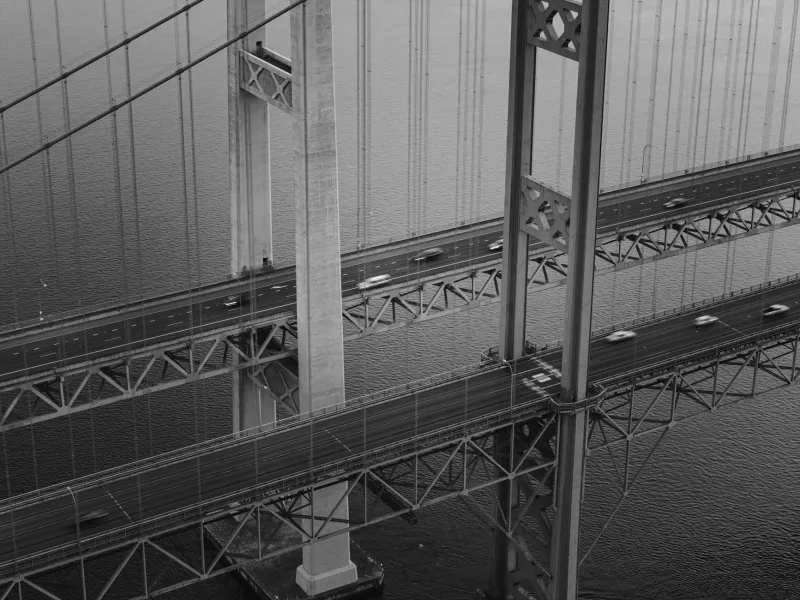
The Bridge That Couldn't Stop Moving
On November 7, 1940, Leonard Coatsworth was driving across what should have been one of America's most stable bridges when it started behaving like a carnival ride. The Tacoma Narrows Bridge — all 5,939 feet of gleaming steel and concrete — was twisting and rolling in waves that made driving impossible.
Coatsworth abandoned his car and crawled to safety on his hands and knees. Minutes later, the entire bridge tore itself apart and plummeted into Puget Sound. The cause? A 42-mile-per-hour breeze that had found the bridge's secret weakness: it loved to dance.
When Engineering Meets Physics (And Loses)
The Tacoma Narrows Bridge collapse remains one of the most spectacular engineering failures in American history, not because of what went wrong, but because of what went right — according to the original design. Engineers had built exactly what they intended: a lightweight, flexible suspension bridge that could handle heavy loads and strong winds.
The problem was resonance, a physics principle so fundamental that it's demonstrated in high school science classes. When the wind hit the bridge deck at just the right frequency, it began to oscillate. Instead of dampening these movements, the bridge's design amplified them, creating larger and larger waves until the structure literally shook itself to pieces.
The Warnings Nobody Heeded
Here's where the story becomes truly absurd: people had been warning about the bridge's behavior for months. Workers nicknamed it "Galloping Gertie" because of its tendency to bounce and sway even in light winds. Local residents made regular trips to watch the bridge undulate — it had become a tourist attraction.
Theodore von Kármán, a renowned aerodynamics expert, had specifically warned that the bridge's narrow deck and solid sides would create dangerous wind effects. His concerns were dismissed by the engineering team, who insisted their calculations were correct. Technically, they were — their calculations just didn't account for the bridge turning into a giant tuning fork.
The Man Who Filmed Disaster
Perhaps the most remarkable aspect of this story is that the entire collapse was captured on film by Barney Elliott, a local camera shop owner who had driven to the bridge specifically to document its famous wobbling. As the bridge began its final dance, Elliott kept filming, creating one of the most dramatic engineering disaster documentaries ever recorded.
The footage shows the bridge deck twisting at impossible angles, with sections rising and falling like ocean swells. Cars bounce helplessly as the roadway beneath them behaves more like a liquid than solid pavement. The final collapse occurs with an almost graceful inevitability, as if the bridge had been choreographed to destroy itself.
The Physics of Self-Destruction
What makes the Tacoma Narrows collapse particularly fascinating is how perfectly it demonstrates resonance frequency. The bridge had a natural frequency of vibration — like a guitar string — and when the wind matched that frequency, the oscillations grew exponentially. Each gust added energy to the system instead of disrupting it.
This phenomenon is so well-understood now that modern engineering students study the Tacoma Narrows Bridge as a textbook example of what happens when you ignore aerodynamics. The irony is that the solution was relatively simple: change the deck design to allow wind to pass through instead of creating lift, or add dampers to absorb the oscillations.
The $6 Million Dance Lesson
The bridge had cost $6.4 million to build — equivalent to about $140 million today. It operated for exactly 129 days before destroying itself. The replacement bridge, completed in 1950, incorporated hard-learned lessons about wind resistance and included features specifically designed to prevent resonance.
The insurance company initially refused to pay, arguing that the collapse was caused by "an act of God." The lengthy legal battle that followed established important precedents for engineering liability and changed how infrastructure projects approach risk assessment.
A Legacy That Still Resonates
Today, the Tacoma Narrows Bridge collapse is required viewing in engineering programs worldwide. The original bridge's failure led to revolutionary changes in suspension bridge design, wind tunnel testing, and structural dynamics analysis. Modern bridges undergo extensive aerodynamic testing to prevent similar disasters.
The most absurd part of this entire story? The engineering team had access to all the knowledge they needed to prevent the collapse. The principles of resonance were well-established, and wind tunnel testing technology existed. They simply chose to prioritize aesthetics and cost savings over physics.
The Bridge That Taught the World
Barney Elliott's film footage has been viewed by millions of engineering students, making the Tacoma Narrows Bridge one of the most educational disasters in history. The bridge that was supposed to connect two sides of Puget Sound instead connected the engineering community to a fundamental truth: nature always has the last dance.
Sometimes the most expensive lessons come from ignoring the simplest principles. And sometimes, a gentle breeze can teach engineers more about physics than years of calculations — if they're humble enough to listen.