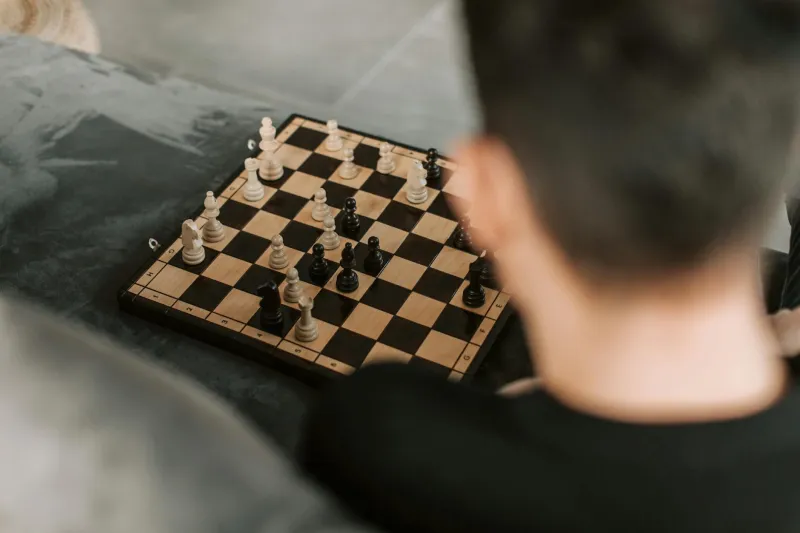
The Day Chess Became a Contact Sport
Picture this: You're sitting in a packed auditorium in Budapest, 1960. On stage sits a 29-year-old Hungarian man with his eyes covered by a thick blindfold, hands folded calmly in his lap. Around him, 52 chess boards are arranged in a semicircle, each manned by a different opponent. For the next eight hours, Janos Flesch will play every single one of them—without looking at a board even once.
If that sounds impossible, you're not alone. Chess grandmasters regularly struggle to keep track of a single game when they can't see the pieces. Flesch was about to juggle 52 of them using nothing but his memory.
The Human Calculator Who Thought in Chess
Flesch wasn't just any chess player. By 1960, he'd already earned his grandmaster title and represented Hungary in international competitions. But what set him apart wasn't his ranking—it was his freakish ability to visualize chess positions in his head with photographic precision.
The concept of blindfold chess isn't new. Players have been testing their memory against unseen boards for centuries. But most grandmasters consider playing three or four blindfold games simultaneously to be a serious mental workout. Flesch was about to multiply that by more than ten.
The rules were simple: Each opponent would announce their move aloud, and Flesch would respond immediately with his counter-move. No notes, no assistance, no peeking. Just a human brain keeping track of 1,664 pieces across 52 different battlefields.
When Memory Becomes a Superpower
As the exhibition began, something extraordinary happened. Flesch didn't just remember the positions—he started playing at a level that would make sighted grandmasters jealous. He won 31 games, drew 18, and lost only 3. That's a 77% success rate against dozens of competent players while literally flying blind.
But here's where it gets truly absurd: Halfway through the marathon, Flesch began calling out moves for games that hadn't been touched in over an hour. He'd suddenly announce "Queen to King's Bishop 3 on board 17" without being prompted, having apparently been calculating combinations in the background while managing 51 other games.
Spectators watched in stunned silence as this blindfolded man demonstrated a type of mental processing that seemed to violate the basic laws of human cognition. Neuroscientists who studied the feat later admitted they had no framework for understanding how a single brain could maintain that level of parallel processing.
The Athletic Debate Nobody Saw Coming
Flesch's performance raised an uncomfortable question: What exactly counts as athletics? Here was a man who'd just completed an eight-hour endurance test that left him physically exhausted, mentally drained, and covered in sweat. He'd demonstrated reflexes, stamina, and hand-eye coordination (even without the eye part).
Yet chess players weren't considered athletes by most definitions. The International Olympic Committee wouldn't recognize chess as a sport for another 40 years. Flesch had essentially performed the mental equivalent of running a marathon while juggling flaming torches, but because he was sitting down the whole time, nobody knew what to call it.
The Record That Still Stands
Sixty-three years later, Flesch's record remains unbroken. Not because nobody has tried—several grandmasters have attempted to surpass 52 simultaneous blindfold games. They've all failed spectacularly, usually tapping out around game 20 when their mental filing systems collapsed under the weight of too much information.
Modern chess computers can easily manage thousands of games simultaneously, but they're using silicon memory and digital processors. Flesch was running on glucose and gray matter, storing positions in the same brain tissue that most people use to remember where they put their car keys.
The Science Nobody Could Explain
Researchers who studied Flesch's feat discovered something troubling: They couldn't replicate or explain what he'd accomplished. Brain scans of modern chess masters show intense activity in the visual cortex when playing blindfold chess, but even elite players max out at around six simultaneous games before their neural networks start throwing error messages.
Flesch had somehow managed to partition his consciousness into 52 separate chess-playing entities, each maintaining perfect awareness of its own game state while sharing processing power with 51 others. It's like discovering someone who can write 52 different novels simultaneously without mixing up the characters.
The Quiet Revolution
Perhaps most remarkably, Flesch's achievement barely registered outside the chess world. While Americans were obsessing over baseball statistics and football records, a Hungarian librarian (yes, he was also a librarian) had just redefined the outer limits of human mental performance.
No endorsement deals, no ticker-tape parades, no cereal boxes. Just a man who proved that the human brain could do things that seemed mathematically impossible, then went back to cataloging books like nothing had happened.
Today, as we marvel at artificial intelligence and machine learning, it's worth remembering that in 1960, a blindfolded chess player demonstrated information processing capabilities that still make computer scientists scratch their heads. Sometimes the most incredible athletic feats happen when nobody's looking—literally.