When America's Cavalry Went Full Lawrence of Arabia in the Wild West
The Most Logical Idea That Sounds Completely Insane
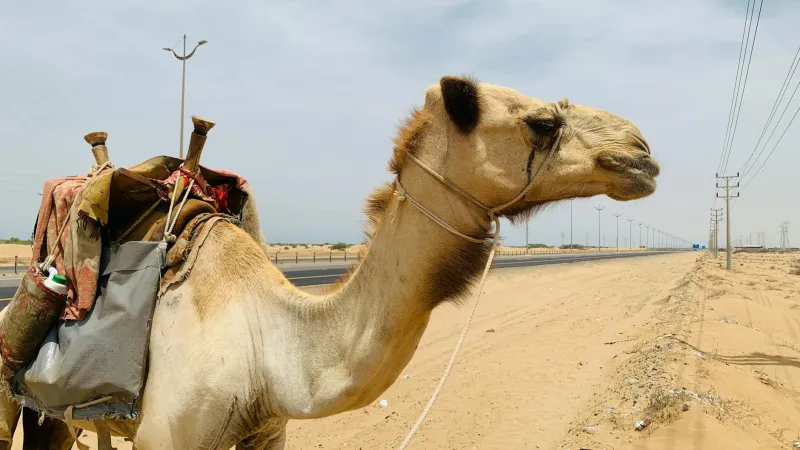
Somewhere in the vast archives of American military history sits one of the most reasonable proposals ever submitted to Congress — and it sounds absolutely ridiculous. In 1855, Secretary of War Jefferson Davis (yes, that Jefferson Davis) convinced lawmakers to fund an ambitious experiment: importing camels from Egypt and Tunisia to serve as pack animals for the U.S. Army across the desert Southwest.
The idea wasn't born from some fever dream or bureaucratic madness. It was actually brilliant military strategy disguised as something out of a children's storybook.
Desert Logistics and the Mule Problem
The mid-1850s presented the American military with a genuine logistical nightmare. The recent Mexican-American War had added vast stretches of desert territory to the United States, and the Army needed to establish supply lines across landscapes that seemed designed to kill horses, mules, and humans with equal efficiency.
Traditional pack animals were struggling catastrophically in the Southwest. Mules required enormous quantities of water and feed that simply didn't exist in the desert. Horses fared even worse, often collapsing from heat exhaustion before completing their missions. The Army was losing more animals to the environment than to enemy action, and something had to change.
Enter Lieutenant Edward Fitzgerald Beale, a naval officer with an unconventional solution. Beale had spent time in the Middle East and witnessed firsthand how camels thrived in conditions that would kill other animals. He proposed what seemed obvious to him and insane to everyone else: if camels worked in the Arabian Desert, why wouldn't they work in the American one?
Hi Jolly and the Great Camel Corps
Congress, in a rare moment of practical thinking, allocated $30,000 for the experiment — roughly $1 million in today's money. The Army dispatched Major Henry Wayne to the Mediterranean with orders that must have raised eyebrows at every port: purchase the finest camels money could buy and ship them to Texas.
Wayne's shopping expedition was surreal even by military standards. He negotiated with Egyptian camel dealers, inspected dromedaries like they were artillery pieces, and eventually selected 33 animals for transport to America. But camels without handlers would be useless, so Wayne also hired Hadji Ali, a Syrian camel driver whose name American soldiers immediately corrupted into "Hi Jolly."
The sight of Hi Jolly leading a caravan of camels through the Texas desert must have been something to behold. Here was a man in traditional Middle Eastern robes, speaking Arabic to animals that looked like they'd wandered off the set of a Biblical epic, all while wearing a U.S. Army uniform.
The Experiment That Actually Worked
The truly absurd part of the Camel Corps story isn't that it failed spectacularly — it's that it succeeded beyond anyone's wildest expectations. The camels proved everything their advocates had promised and more.
They could carry twice the load of a mule while requiring half the water and feed. Where horses and mules needed 20-30 pounds of fodder daily, camels could survive on desert scrub that other animals wouldn't touch. They could go for days without water in temperatures that would kill a horse within hours.
Lieutenant Beale led the first major camel expedition in 1857, surveying a wagon road from New Mexico to California. His official report reads like a love letter to his four-legged companions: "The camels are admirably adapted to the country," he wrote. "They pack water for others, and themselves drink the muddy water of the streams with great relish."
The camels even proved themselves in combat situations, carrying supplies to remote outposts and participating in military operations against hostile tribes. Soldiers initially mocked the "ship of the desert" but gradually came to respect animals that could outperform every other pack animal in the Army's inventory.
Why Success Led to Failure
So if the Camel Corps worked so well, why isn't the U.S. military still using camels today? The answer reveals something uniquely American about how we approach innovation: we abandoned a successful experiment for reasons that had nothing to do with the experiment itself.
First came the Civil War. Jefferson Davis, the program's primary advocate, resigned to become President of the Confederacy, leaving the camels without their most powerful political supporter. Military priorities shifted dramatically, and funding for exotic experiments dried up overnight.
More importantly, the transcontinental railroad was rapidly making pack animals of any species obsolete for long-distance transport. Why maintain a camel corps when you could move supplies by train? The same technological progress that had created America's need for desert pack animals was simultaneously making them unnecessary.
The Great Camel Diaspora
As the Army lost interest in its Middle Eastern imports, the camels faced an uncertain future. Some were sold to circuses and zoos. Others were auctioned off to private owners who had no idea how to care for animals adapted to desert life. Many were simply turned loose to fend for themselves in the American Southwest.
Hi Jolly, the Syrian camel driver who had traveled thousands of miles to serve his adopted country, found himself unemployed and stranded in Arizona with a herd of animals nobody wanted. He spent his remaining years as a prospector and occasional scout, becoming something of a local legend before dying in 1902.
For decades afterward, ranchers across the Southwest reported sightings of wild camels roaming the desert. The last confirmed wild camel was spotted in Texas in 1941 — nearly 80 years after the Army had given up on the experiment.
The Logic of the Absurd
The Camel Corps remains one of the most perfectly American stories ever recorded: a government program that succeeded completely while failing utterly. It demonstrated both the country's willingness to try bold experiments and its tendency to abandon good ideas for entirely unrelated reasons.
In an age when military innovation often meant bigger cannons or faster ships, the Army had the wisdom to recognize that sometimes the best solution was the oldest one. Camels had been moving supplies across deserts for thousands of years — it took genuine insight to realize that American deserts weren't fundamentally different from Middle Eastern ones.
Yet the program's ultimate failure also captures something essentially American: our faith in technological solutions over traditional ones. Even when the old ways worked perfectly, we preferred to bet on railroads and machines rather than animals and ancient wisdom.
Today, a monument in Quartzsite, Arizona, honors Hi Jolly and his camels — a reminder of the time America's cavalry went full Lawrence of Arabia and it actually made perfect sense. Sometimes the most logical ideas sound the most absurd, and sometimes the most absurd experiments work exactly as advertised.